growing lettuce through winter in Ireland

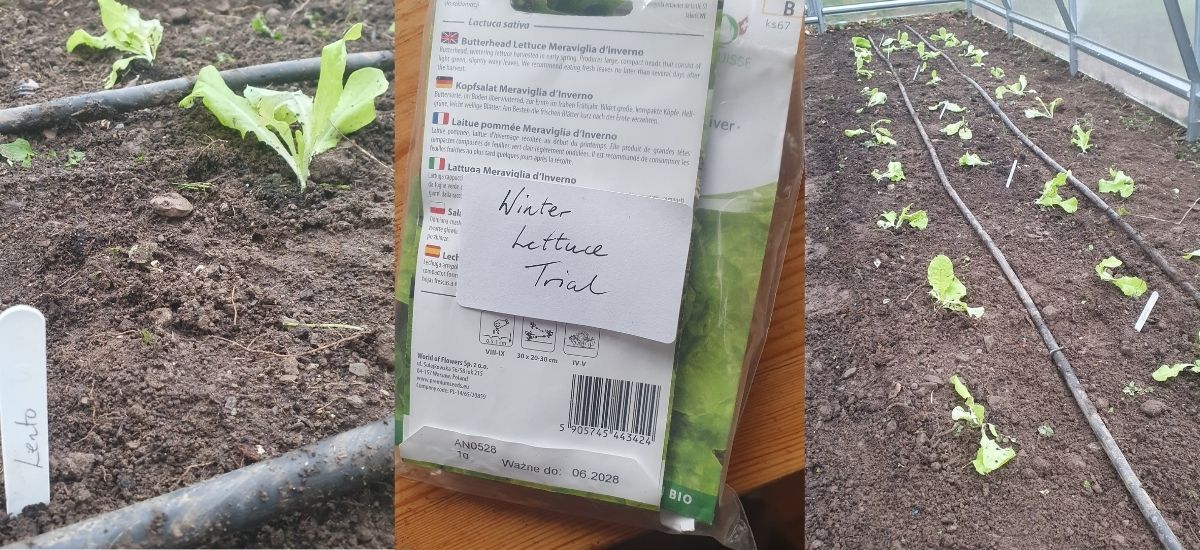
Winter Butterhead Lettuce Trial

It would be nice to do proper trials (large plant numbers, randomised blocks, clipboards and the like) but I think plenty can be gleaned from little observational trials. It is a great exercise for any gardener to grow a few varieties of the same crop side by side and see how they differ. The differences can be trivial or vast and you might find that you were growing an unproductive variety or one not suited to your soil.

Here is one I just planted of winter lettuce butterhead varieties. I sourced various varieties that were described as ‘winter’ or ‘early’ – typically with a recommended sowing in September for expected harvest in April. These were sown at the end of September and transplanted into a tunnel on Halloween, that’s Samhain to you heathens. I also threw in a summer variety to see how differently it behaves.

I gave them plenty space of to observe them better. And with the expectation that some will be grown on for seed next year.

In Ireland, with our mild winters it is possible to grow most lettuce varieties in a tunnel this way. I would stick with looser leaved varieties though as they seem less fussy and are faster growing. Plants will grow very slowly over the winter in the low light levels but will start to produce as early as February the following year and should provide leaves for a few months after that if only the outer leaves are harvested periodically. The early start also means the plants will be going to flower at the ideal time to save seed from them.

Varieties in the trial

  • Meraviglia d’inverno
  • Mira
  • Rosemarry
  • Valdor
  • Humil
  • Lento

Similar Posts

  • What is F1 Hybrid Seed?

    One of the first things would-be seed savers learn is that you ‘cannot save seed from F1 hybrids’. Though usually not true, it is still rarely worth doing as the crops produced from them will be unpredictable in their growth form. Hopefully the following will shed some light on the terminology of F1 seed, why…

  • Seed Processing with Fermentation

    Plants which have fruits require wet processing to extract and clean the seed. With vegetables, this applies to the Solanaceae and Cucurbit families. Tomato and cucumber seeds are surrounded by a germination inhibiting sac to prevent them from germinating in the wet environment of their particular fruits. These need fermentation to remove that gelatinous layer….

  • Soil Temperature by County

    Current soil temperatures in counties where Met Éireann take measurements. A 7 day average is used as it provides a more stable and reliable reading by smoothing out daily fluctuations. Similarly, readings are taken at a depth of 10cm as it provides a good compromise between the more fluctuating temperatures found nearer the surface due…

  • Beanbasket

    Growing Broad Beans for Drying Recent archaeological digs have shown that fava beans (Vicia faba) were first cultivated in the Levant more than 10,000 years ago. This places them in close company with the domestication and early farming of cereals. They must have provided early farmers with the much needed protein which is lacking from…

  • Cleaning Radish Seed

    Radish (Raphanus sativus) seed is one of the more fiddly seed to get clean. This is because the seed tends to get bound up in the fibrous innards of the pods. Threshing is the tricky bit. It’s fine to do small amounts by hand just rubbing out the seed but the doesn’t cut it for…

  • Sugar Snap Search

    There are not that many sugar snap pea varieties around and in my experience some of them are very poor, or even wrongly advertised stringy creatures. Until I have the resources to conduct proper systematic trials I am usually just assessing varieties, eh, hand to mouth.. I sourced four varieties this year and have been…

Leave a Reply