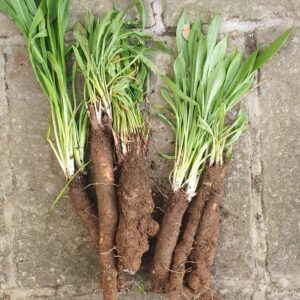
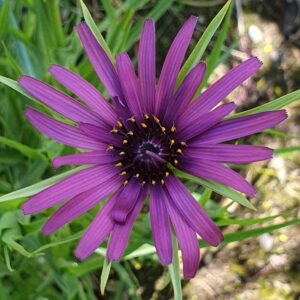
Scorzonera (Pseudopodospermum hispanicum) are grown for their long soft tap roots. The leaves and flower buds are also edible. It is also known as black salsify. The roots are black on the outside and have a white flesh on the inside and are also part of the sunflower family. For edible roots scorzonera is grown as an annual. For seed it is grown as a biennial. The roots will overwinter in the ground and produce an abundance of yellow flowers in the second year.
Direct sow seeds thinly in shallow drills 1cm deep from late April. Give 30cm space between rows. Scorzonera seed does not keep well so is best sown in the year it is sourced. Germination is slow and erratic and can take 2-3 weeks. After a few more weeks plants can be thinned to leave the strongest grow on.
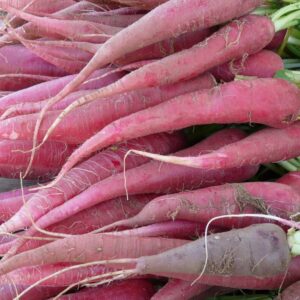
A heirloom Italian radish (Raphanus sativus) with bright red tapered roots that have a firm white flesh. ‘Candela di fuoco’ translates to ‘fire candle’. Quick to mature and can be harvested after 3-5 weeks.
Though in appearance like a winter daikon radish, it is a summer radish so for eating quality they are best grown and eaten fresh. However, for seed saving it is useful to overwinter them from a late summer/early autumn sowing. That way, the roots will flower early and should be ripening seed during the summer when conditions are, in theory, optimal.
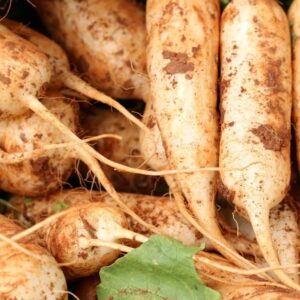
‘White Icicle’ is a summer radish (Raphanus sativus) which produces medium sized pure white tapered roots. Quick to mature and can be harvested after 3-5 weeks. Can be sown indoors from March and outdoors from April. Sow in a row with seeds 1.5cm apart and 25cm apart. Thin out as necessary after a couple of weeks. It is good to sow a small row every few weeks of the season to keep a steady supply.
Though in appearance like a winter daikon radish, it is a summer radish so for eating quality they are best grown and eaten fresh. However, for seed saving it is useful to overwinter them from a late summer/early autumn sowing. That way, the roots will flower early and should be ripening seed during the summer when conditions are, in theory, optimal.
A round heirloom radish (Raphanus sativus) which produces roots with black textured skin that covers crisp white flesh inside. Medium to large variety producing radishes 5-10cm in diameter. They take a little longer to grow than other varieties but are larger, winter hardy and store better. Great for later sowings.
Salsify (Tragopogon porrifolius) is an uncommon but easy to grow root crop. Direct sow in Spring for harvest in the winter. The roots are long, slender and have been described as oyster flavoured. Roots can be replanted, or left in situ, and will flower and set seed in the second year. Flowers are ornamental and edible. Young leaves can be eaten raw or cooked like spinach and even the young shoots can be eaten like asparagus.
Salsify is an ancient food crop from south east Europe and North Africa which is referenced often in plant books throughout antiquity. Though it is largely out of favour now and not widely grown. It is part of the Asteraceae family, like lettuce and sunflowers, so what we consider the ‘flower head’ is actually a basket shaped head containing many individual (sessile) flowers. Each of these flowers will produce a seed when fertilised. Seeds are long and rod shaped with ribs. They have feathery hairs, known as a pappus, to aid with wind dispersal, as do many seeds in this family.
Sow in well prepared deep loose soil so that roots can stretch their legs. Sow seeds in shallow drills 1cm deep with 30cm between rows. Germination can be erratic – some seeds will germinate in a few days with most taking 2 to 3 weeks. Once they are on the way, thin plants to around 8- 10cm apart. After that, they need very little attention.
‘Lenka’ (Daucus carota) is a medium early variety that is grown for fresh eating or for short term storing. It produces sweet flavoured, cylindrical bright orange roots. Can be succession sown. For fresh eating, sow from April outside and for use as a maincrop or storing carrot sow in June. Carrots should be sown directly in rows ~30cm apart. After a few weeks, thin out seedlings until about 5cm apart.
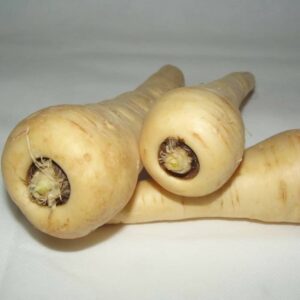
White Gem is a well established parsnip variety. With shorter roots than other varieties, it is suitable for all soils including heavier clay types. It has decent resistance to canker and nice smooth skin.
Direct sow in April/May when the soil has warmed up enough. Parsnip seed is slow enough to germinate and has a lower viability than other seed so early sowings in cold conditions increase the likelihood of seeds failing. Parsnip seed also has a short vitality so it is best not to keep seed for the following year. Sow generously in a drill aiming to drop a seed every 2-3cm and thin out to around 10-15cm when the seedlings have emerged. Make sure the soil does not dry out while the seeds are germinating. Once the precarious germination period has passed and the seedlings are thinned to their final spacing there is very little to do until harvest; just an occasional weeding.
Parsnips store best left in the ground and harvested as required. They are reported to improve in flavour after frost but I don’t notice any difference.
Average 400 seeds per packet.
10g average 2,000 seeds