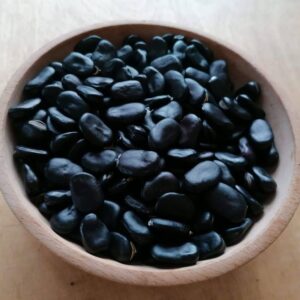
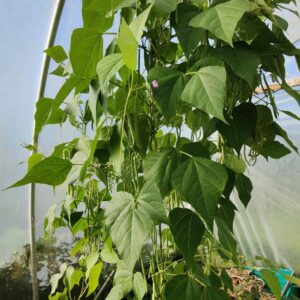
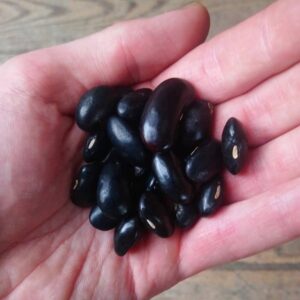
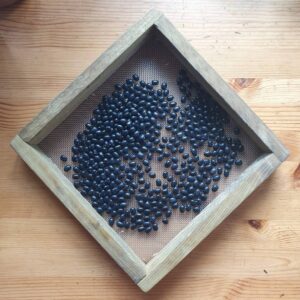
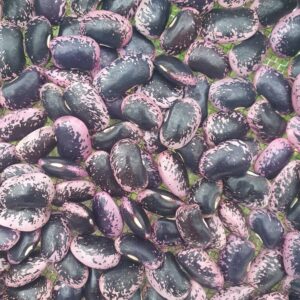
Sourced from the Irish Seed Savers. An ancient variety grown in Russia since time out of mind. They are very hardy and I have saved seed from them in very wet and windy summers whereas other varieties I tried succumbed to chocolate spot. Plants are a bit over a meter high so need supporting. The mature beans are a deep dark purple almost black. I grow them for the dry beans and have used in stews, ful madames and such.
Sow directly in the soil from late February until the end of April. Early sowings are less vulnerable to black bean aphid (blackfly) damage as the plants are well established before they strike.
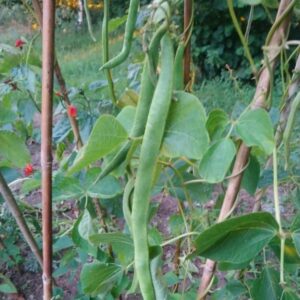
‘Cobra’ is an extremely reliable climbing French bean (Phaseolus vulgaris) well known in Ireland. Found often in kitchen and market gardens here due to its consistent heavy crops. It produces well both inside an outside, even producing a great crop and ripening seed outside in the dismal 2024 summer. The beans are stringless, long (up to 20cm) and round.
Climbing French beans are a very productive use of space. They can be grown up a trellis net, string lines or bamboo canes and will climb to around 170cm. Don’t worry when you have a glut. They are easy to blanch and freeze or if you don’t get around to that you can let the beans dry and use them like any dry beans. Cobra is a black seeded variety.
They can be sown directly in the soil when risk of frost has passed. I plant them in May outside as I don’t see any advantage to pushing them too early as they will develop very slowly until the soil warms up anyways. You can make another sowing a few weeks later to extend the cropping period.
Sourced from Irish Seed Savers, this is a selection from ‘Scarlet’ so has the attractive clusters of red flowers. The dried beans are a deep shiny black colour and great for stews etc. Grows vigorously.
Madeline gave me some of this seed from her stash. I found it just as she describes – good sized beans (Phaseolus vulgaris) which mature early and are good for drying. They were unaffected by the regular rain during their last few weeks of ripening. Can be eaten as a green bean. Noted as a French heirloom variety.
A heritage German runner bean that I sourced from Irish Seed Savers. Produced lots of short runner beans which ripened really well into dry beans outside. I speculate that the shorter podded varieties might be best for producing dry beans as the pods seem to ripen and dry more quickly.
A nice relatively stringless scarlet flowered runner bean. This variety is slow enough to produce seed so the pods can be left on the plant longer before getting too tough to be edible.
This red haricot bean came from Hodmedod’s in the UK. It is a variety which was bred by the late Colin Leakey who was a prolific plant scientist and breeder. He had a lot of expertise with Phaseolus vulgaris in particular and was heavily involved with adapting beans to grow better in UK conditions.
‘Stop’ is grown as a canning bean in the UK so it is a bush variety for combining. I’m not sure if combining beans in Ireland will ever be feasible due to the necessity for dry conditions at ripening and harvest time. However, at a home scale, whole plants can be pulled in to bring in and dry when weather dictates. It is possible to grow a considerable amount of your own protein this way. A few square meters yields around a kilo of dried beans. I found it grew very easily, ripened early and had a good yield.
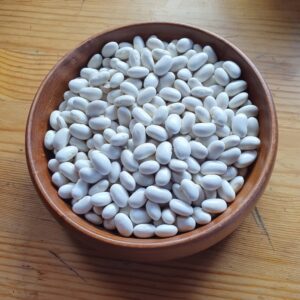
One I tried in my pursuit of good dwarf beans (Phaseolus vulgaris) to produce dry beans in Ireland. I sourced ‘Aura’ from Poland where it is grown on large scale and was reported to be a very early maturing variety and highly resistant to diseases. It was both those in 2023 where it produced a healthy crop of dry beans in the very wet and windy summer.
Strong stems which keep the beans off the ground and prevent the crop from lodging. Plants are about 40cm tall and flowers are white. When ripe the pods are pale yellow. If weather is bad when ready to be harvested the whole plants can be pulled up and brought inside to dry before shelling.
Wait until the soil has warmed up sufficiently if direct sowing. This means May/June in Ireland. Sow ~10cm apart in rows with 50cm between.
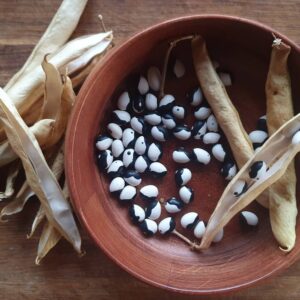
The Orca (Orcaaasaa♫aaaaaaaaaaaaaaaaaaa … Orca .. Killer Whale) Bean is a dwarf french bean known for it’s distinctive pattern on the dry seed. Grown this year to mark the 22nd anniversary of an infamous fishing trip taken by three killer whales to Cork City.
Also known as the ‘Ying Yang Bean’ … for some reason. They can be eaten as fresh beans or used like haricot beans when dried. Wait until the soil has warmed up sufficiently if direct sowing. This means May/June in Ireland. Sow ~10cm apart in rows with 50cm. Can be sown a few weeks earlier in a polytunnel or glasshouse.
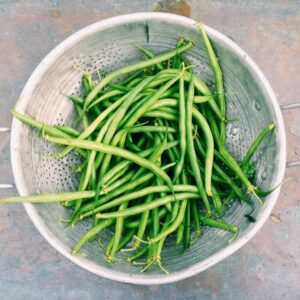
A long podded french bean (Phaseolus vulgaris) which yields heavily. Pods are dark green, round and 17-19cm length. Resistant to bean mosaic virus and anthracnose. Wait until the soil has warmed up sufficiently if direct sowing. This means May/June in Ireland. Sow ~10cm apart in rows with 50cm.
On a home scale climbing french beans are more productive than dwarf varieties. French beans also yield more in a glasshouse or polytunnel. However, with market gardening in mind, it is not so practical to support large numbers of plants and tunnel space is precious. So I am interested in how productive dwarf french beans can be when grown outside in Ireland. I hope to do a proper variety trial soon. It would be important to have varieties with different maturation rates to spread out the harvest window. Caruso is considered a mid season variety.
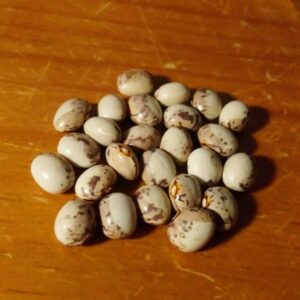
An old French variety of climbing bean (Phaseolus vulgaris). Can be eaten young as green beans or allowed to mature and be harvested as dry beans. The dry beans have a striking cream and purple/brown mottled pattern and can be used in stews, casseroles and the like. In Ireland, french beans can be sown directly outside in June when the soil is sufficiently warm. Alternatively, you can plant them indoors in pots a few weeks beforehand to give them a head start on slugs when planted out.