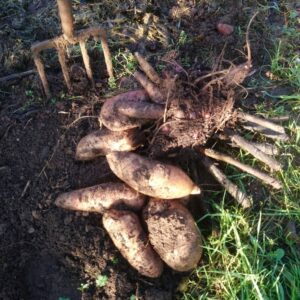
Yacon (Smallanthus sonchifolius) is a perennial tuber from south America which grows well in Ireland and is very easy to propagate. Above the large edible tubers are found small knobby propagative tubers. You will receive 3 of these in a small bag of compost. Pot them up in a frost free place. I sow them in 2 litre pots in the polytunnel and throw some crop cover net over them if the temperature drops. They can be planted out when risk of frost has passed and need about a square meter of space in good light. Otherwise very unfussy.
Once they get going they will put out large leaves and can reach a height of 2m. They can flower in Autumn and are ready to harvest when the first frost kills off the leafy growth. You should get a few kg of edible tubers from each plant and plenty of propagative tubers for the following year.
The tubers look like sweet potatoes but that’s where the similarity ends. Their flesh is crisp and juicy, more like the texture of a crisp apple. They are nice to eat raw and feel more like eating a bland but refreshing fruit rather than a tuber. You will find fanciful claims that they taste a bit like pears/apples/celery/watermelon/etc. They don’t. I haven’t tried cooking them yet but my friend from Mexico says that they use them in stews over there.
Yacon is also used to make a sugar syrup and has gotten a lot of interest in this regard as the carbohydrates are in the form of fructooligosaccharides, which as well being a impossible to pronounce, are also impossible to digest so provide a food source for probiotic bacteria in the gut.
Horseradish (Armoracia rusticana) is a hardy perennial plant in the Brassicaceae family which is grown primarily for its roots to make a spicy condiment. Variations of horseradish sauce are used throughout Europe. Grated horseradish root and vinegar normally serves as the base and may be tweaked with sugar, lemon juice, mustard, garlic, mayonnaise or cream.
The intact root is harmless when harvested. It is after the the flesh is ‘damaged’ through cutting or grating that the enzymes get working to produce the pungent mustard oil compounds. At this stage horseradish is at its most potent and is very irritating to the eyes and mucus membranes. Even in vinegar this pungency will mellow and weaken over a few weeks.
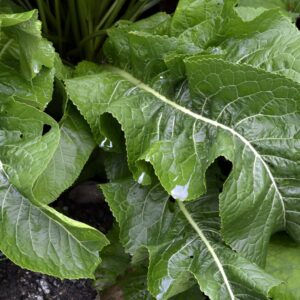
The young leaves are also nice to eat steamed and have a mild flavour. As the plant grows later in the season the leaves get large and resemble overgrown dock leaves. As this stage they are a bit too tough to bother eating. Horseradish has been used though antiquity and is commonly referred to for traditional medicinal use.
You will receive 3 root cuttings in compost. Once you have horseradish you never need to replant it and can easily propagate further from root cuttings. In fact, think twice about where you put it as is not easy to get rid of once established. Will grow in any reasonable soil with sun or partial shade. Deep rooted and clump forming horseradish plants can reach a height of 60cm or so. Being deep rooted it is also a good mineral accumulator.
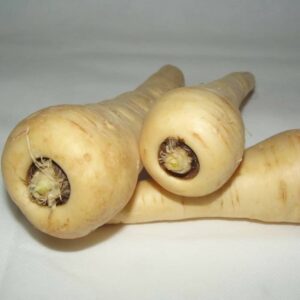
White Gem is a well established parsnip variety. With shorter roots than other varieties, it is suitable for all soils including heavier clay types. It has decent resistance to canker and nice smooth skin.
Direct sow in April/May when the soil has warmed up enough. Parsnip seed is slow enough to germinate and has a lower viability than other seed so early sowings in cold conditions increase the likelihood of seeds failing. Parsnip seed also has a short vitality so it is best not to keep seed for the following year. Sow generously in a drill aiming to drop a seed every 2-3cm and thin out to around 10-15cm when the seedlings have emerged. Make sure the soil does not dry out while the seeds are germinating. Once the precarious germination period has passed and the seedlings are thinned to their final spacing there is very little to do until harvest; just an occasional weeding.
Parsnips store best left in the ground and harvested as required. They are reported to improve in flavour after frost but I don’t notice any difference.
Average 400 seeds per packet.
10g average 2,000 seeds