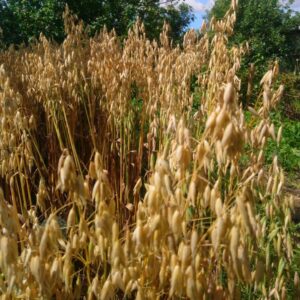
Naked, or hulless, oats (Avena nuda) are an oat that lose their husk naturally during the normal harvesting and threshing process. Because the husk is discarded, you are left with nothing but the highly nutritious oat kernel. This has an advantage for smallholders as they don’t require the large machinery required to process the more common hulled oats.
Naked oats are the perfect choice if you want to roll your own oats. They can also be cooked whole but require a lot more cooking than porridge oats from the shop which are already par cooked by steaming and rolling. They are also a good choice if you want to grow your own chicken feed.
Oats grow and ripen very easily in Ireland. I sow in rows at least wide enough to get a hoe through. Once they get going they will outcompete weeds and need no more attention until harvest.
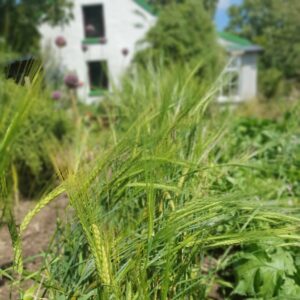
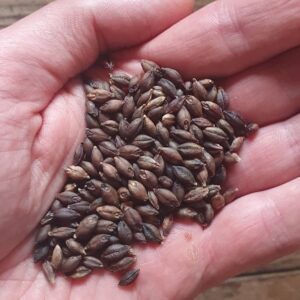
Naked, or hulless, barley is a type of barley (Hordeum vulgare) in which the husks separate easily from the grains. For this reason they are suitable for small scale growing as they don’t need industrial processing. They can be used right from harvest though much of the loose husk will still need to be rubbed off the grains. It is a perfect whole grain and can be cooked in stews, added to salads or to replace rice.
Barley is an ancient grain which was domesticated in the Near East around 10,000 years ago. Originally barley had a tight indigestible hull which needed to be removed by processing. At some point a genetic mutation which caused the hull to shed easily occurred and this trait spread rapidly. It was a major crop for humans until it was largely displaced by bread wheat which, with it’s high gluten content, could be used to make leavened bread. Barley became mostly used for brewing and animal feed where hulled varieties are more useful due to higher yields and other reasons. Naked barley was most likely what was introduced into Ireland around 4000-3000BC by European Neolithic farmers who also brought with them wheat, cattle, sheep and goats. This period marks the transition from hunter gathering lifestyles to farming in Ireland.
‘Pirona’ is a Spring barley so should be sown around March/April. I sow it in rows with a hoe’s width between so I can easily weed until they are established. It is generally recommended to sow barley at a rate of 300 plants per m2. For example, if there was 20cm between your rows then you would be sowing a seed approx. every 1.5cm to achieve this rate. Sowing too densely will cause the crop to lodge/fall over in bad weather (from experience!).
A black hulled oat (Avena sativa) that was sent to me by a researcher in Teagasc. It is a husked Spring sown variety. It is tall reaching nearly 2m. Traditionally black coloured oats were favoured by horse breeders. They are higher in protein and antioxidants – horses fed on black oats were said to ‘go the extra furlong’.
Oats grow and ripen very easily in Ireland. I sow in rows at least wide enough to get a hoe through. Once they get going they will outcompete weeds and need no more attention until harvest.
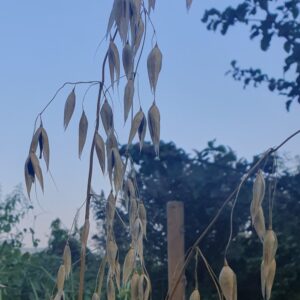
‘Oliver’ is a spring sown naked oat which has a low content of hulled grains. Even naked oats will have some grains with hulls that are difficult to remove without rubbing.
There was crown rust on the crop in 2024 but it did not seem to effect yield. Oliver is resistant to lodging but it is always a good idea to grow oats in poorer soil. Too much soft growth from excess nitrogen causes weak stems. Oats are ideal for low-input production.
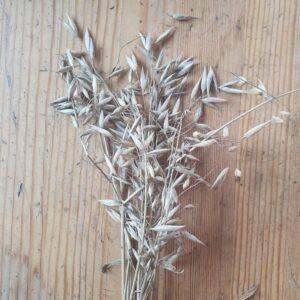
An oat (Avena sativa) that I sourced from the Irish Seed Savers. Ayr Bounty oats have been grown since 1937. According to the Agronomy Institute of Orkney College they were still being grown on a few farms in Orkney until very recently. It is a husked Spring sown variety.
Oats grow and ripen very easily in Ireland. I sow in rows at least wide enough to get a hoe through. Once they get going they will outcompete weeds and need no more attention until harvest.
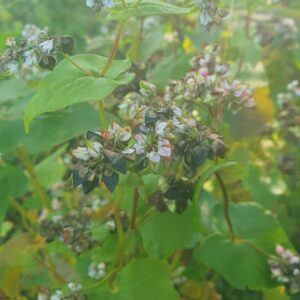
Buckwheat (Fagopyrum esculentum) is an annual plant that belongs to the Polygonaceae or knotweed family. As a food, buckwheat is grown for its seed which is made into gluten free flour or groats. It is the flour used for the Breton galette – a delicious savory pancake. I have not done much cooking with the groats but they are a staple in Eastern Europe and Russia. I have a Polish friend who is still traumatised from being overexposed as a child.
‘Kora’ is a variety which is noted for being resilient to spring frosts as well as drought. It ripens in about 12 weeks. I planted it a bit late this year, around mid June. I learned the hard way about the difficulty in timing the seed harvest. Buckwheat seeds ripen unevenly and they mature while the plant is still largely green. They are normally harvested when 3/4 of the seeds are brown. So some of the first seeds will be lost and a proportion will be immature. It is a small harvest window and if left too late shattering will occur and a lot of the seed will be lost. This happened to me, and alongside the awful weather at ripening time, led to a small yield.
I am still trying to figure out how to process the seeds into an edible form. Apparently they can be lightly roasted, milled and then sieved to get a flour which will have most of the hull removed.
Originating from Ethiopia, ‘Jet’ Barley is a spring planted 2 row hulless barley with a massive protein content (16%). It has been shown to be unaffected by drought in the early stages of development. It is also reported to have high resistance to smut – a disease of barley caused by the fungus Ustilago nuda.
Lodged (fell over) a bit in 2024 as did many grains in that wet summer. Excess fertility can also cause this to happen as too much nitrogen causes cereals to produce taller skinnier stems which are prone to collapse. Not planting too densely also helps.
I sow it in rows with a hoe’s width between so I can easily weed until they are established. It is generally recommended to sow barley at a rate of 300 plants per m2. For example, if there was 20cm between your rows then you would be sowing a seed approx. every 1.5cm to achieve this rate.